SPARTACUS
Methodology
Bookmarks on this page
Approach to urban sustainability
Conceptual issues
Impact chains
The indicator system
From Indicators to Indices
Approach to urban sustainability
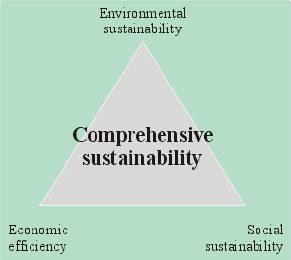
The three components of sustainability generally referred to in the literature (e.g. Munasinghe, 1993; Alberti, 1995; Hannequart & Schamp, 1995; Gardner & Carlsen, 1996; World Bank, 1996) have been taken as the points of departure for the SPARTACUS system. They are interpreted as follows.
Environmental limits are posed by the exhaustion of natural resources and exceeding natural carrying capacities.
Social sustainability includes analysis of the distribution of policy impacts and access to resources and services, the justice of those distributions as well as of the state of the community with regard to health determinants and the opportunities people have.
Economic efficiency of the use of resources examines whether most benefits are achieved with least use of resources.
Conceptual issues
By definition, a city as such cannot be sustained unless all of its (relevant) components are sustainable. However, evaluating the sustainability of an urban system as a whole is a task beyond the present scope. The mere fact that SPARTACUS has not been looking at the totality of the urban system but only parts thereof prevents the measurement of its degree of absolute sustainability even in principle.
In the wider picture it is similarly unclear whether urban sustainability—again in absolute terms—is a meaningful concept. This is because, by definition, the sustainability of a system which is dependent on an external system cannot be evaluated without also examining the external system (which then loses its externality).
Despite these difficulties, it is the contention of the SPARTACUS project that urban sustainability can and should be measured, in relative terms. Policies therefore have been compared against each other with the help of the indicators.
Impact chains
One of the central principles in the selection of the indicators has been to follow the causal chains of impacts as far as possible. It is not unusual to describe the sustainability implications of policies e.g. in terms of how they affect various transport variables. Usually the quantification concludes with estimates of emissions.
Regarding for example air pollutants, several of the SPARTACUS indicators deal with emissions. For impacts depending on local concentrations, the concentrations within the study areas are modelled. However, the next stage, modelling of exposure, is not quite reached; the concentration data are combined with information on where people live, and the result is a simplified indication of potential exposure in residential areas.
In addition to the actual indicators, a good deal of explanatory information is available from the SPARTACUS system including information which helps in the interpretation of changes in the values of the indicators. These data are called background variables.
The indicator system
The indicator system consists of three components in accordance with the three components of sustainability: environmental, social and economic. The indicators are grouped under themes. Indices are then built from the indicator values. For this purpose, the environmental and social indicators, which do not have a natural common unit, are scaled in the range [0…1] with user-defined value functions. Subsequently, the indicator values can be aggregated to the theme-level indices using indicator-specific weights, and further to component-level indices applying theme-specific weights. The component-level indices are not combined, because no substitution is assumed possible between them.
The economic index is expressed in one single value (ECU/capita/a) describing the benefits of any policy. It is composed of transport user benefits, transport operator benefits as well as resource and external cost savings.
The components, themes and indicators of urban sustainability in the SPARTACUS system.
From Indicators to Indeces
Phase I: Deriving indicator values
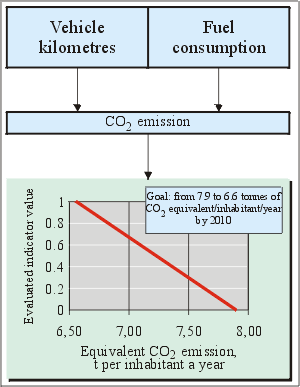
Sustainability indicator values are calculated from transport and land use variables.
Phase II: Evaluating the indicator value
Indicator values are scaled to the range 0...1, ie. transformed into so called evaluated indicator values Ie using value functions. They are based on indicator specific targets. Achieving the target results in a unity value for Ie, and a specified bad performance in a zero value.
Phase III: Weighting the impacts
The sustainability indicators are divided into economic, environmental and social components. Within each component, the impacts are given weights in respect to each other by comparing the importance of achieving the target of each indicator. The themes are also compared against each other.
Phase IV: Aggregating the indicators
Using the weights derived, the indicators are aggregated to the theme level and sustainability goal achievement indices.
Policy testing indicators
SPARTACUS will calculate values for the indicators of environmental and social sustainability and economic efficiency based on the results of the MEPLAN land-use transport model. The sustainability themes cover e.g. air pollution, resource use, equity, safety and opportunities. Efficiency analysis will look at the costs and benefits of the tested policies.
Explanatory Variables
Many sustainability indicator systems present data related to transport and land use statistics (modal split, population density etc.) as indicators. In the SPARTACUS approach, they are available to the User as explanatory variables that explain the behaviour of the indicators, but not included in the indicator system if they do not directly measure sustainability.
Supplementary Indicators
The User will be able to add supplementary indicators to the weighting system and provide their values. The role of the these indicators is to help to maintain a broader view of sustainability than the one provided by the directly measurable policy testing indicators only.